A Little Bird in a Very Large Sea
FIELD NOTES · FROM THE FOUNDRY
On puffins, pretending to be birders, and a bird worth looking for.
See those three gulls? Okay. Now find the patch of grass below them.
Go down a little.
There. You can just see the orange beak.
Oh—he turned around.
There are hundreds of birds on and around Haystack Rock, and my mom and I are staring at a patch of grass.
We look through the binoculars. Nothing.
Back to the gulls. Find the grass. Down a little. Still nothing.
Someone finds him again, and another round of directions ripples through the little group gathered beneath the rock. We adjust the binoculars, retrace the route from the gulls, and look again.
And then, finally, an enormous orange beak appears between the grass and the rocks.
Puffin.
My mom and I are ridiculously excited.
There is absolutely no mistaking him. After all that searching, we have found a Tufted Puffin.
Which is a little ridiculous considering that, until fairly recently, I thought I'd have to go all the way to Iceland to see one.
Puffins had been sitting on my bucket list for years, along with Iceland and the Faroe Islands—the kind of funny little bird I hoped I'd eventually encounter on some future adventure. Then my mom and I planned a trip to the Oregon Coast and I discovered two things at roughly the same time: we'd be there during some of the lowest tides of the year, and Tufted Puffins nest at Cannon Beach.
Obviously, plans changed.
We already wanted to explore the tide pools around Haystack Rock, so if we timed everything right, we could walk out at low tide, hunt through the pools and maybe—maybe—see a puffin.
Then I made the mistake of researching them.
One interesting fact leads to another, which leads to something I didn't even know enough to wonder about five minutes earlier. Suddenly the cute bird I hoped to see someday was a creature I desperately wanted to find in a patch of grass.
My mom is usually right there with me.
We like to pretend we're birders. We own binoculars. We have Merlin Bird ID. If we hear something interesting in a tree or see something unfamiliar fly overhead, there's a good chance one of us is already trying to figure out what it is.
But after spending enough time around actual birders, we've realized we're really not.
We don't need to catalogue every detail or add every sighting to a list. We just like knowing what we're looking at. Birds, rocks, plants, animals—whatever happens to cross our path.
And by the time we arrived at Cannon Beach, we knew enough about Tufted Puffins to be very invested in finding one.
The exceptionally low tide had brought us almost all the way to the base of Haystack Rock, along with what appeared to be every actual birder in Oregon. There were binoculars everywhere, spotting scopes, enormous camera lenses and people who could seemingly identify a bird from three pixels and a wingbeat.
We happily integrated ourselves.
An expert was giving free puffin talks and helping people find the birds nesting high on the rock. That's how we ended up following increasingly specific directions involving gulls, grass and one elusive orange beak.
But once we finally found that first puffin, something happened.
We started finding more.
There were puffins tucked into the vegetation around their nests and others resting on the rock. Every so often, one would launch itself into the air and join the hundreds of birds circling Haystack.
Those became surprisingly easy to spot too.
Not because Tufted Puffins are particularly graceful flyers.
Quite the opposite.
When hundreds of birds are moving around Haystack Rock, look for the one that seems to be working just a little bit harder at the whole flying thing.
There's your puffin.
They're funny little birds. There's really no better way to explain them. The giant orange breeding-season beak doesn't help. Neither do the pale tufts sweeping dramatically behind their heads. Everything about them seems just slightly overdone, as though nature designed a perfectly respectable seabird and then decided it needed more personality.
By the time we left Cannon Beach, we were smitten.
Which is probably why discovering that Tufted Puffins also live in Washington didn't remain a fun fact for very long.
Eventually, it put us on a boat.
My mom had some time off that summer, I was getting back into photography, and we were looking for little adventures close to home. A Puget Sound Express wildlife trip out of Edmonds checked pretty much every box, especially because it would take us toward Smith Island and another chance to see puffins.
This time we weren't stumbling across them during an Oregon Coast trip.
We were going looking for them.
Unfortunately, Cannon Beach had spoiled us.
Smith Island is protected as part of a wildlife refuge, so the boat couldn't get particularly close. Instead of standing almost beneath a nesting colony, we stayed offshore and scanned the water.
There were birds everywhere, scattered through the kelp. We moved from one little dark shape to another, trying to pick the puffins out from everything else floating around us.
Bird.
Bird.
Definitely not a puffin.
Maybe?
No.
Then someone would find one, we'd follow the directions, and there it was.
Most of the puffins we saw were alone. At one point we spotted a small group with an adolescent among them, but what stayed with me were those solitary birds.
After Cannon Beach, it was almost anticlimactic.
And yet there was something I loved about seeing them this way.
At Haystack Rock we'd seen puffins nesting, resting and bumbling through the air. Those were the puffins people travel to see—the colorful breeding-season birds gathered around a dramatic colony.
Out here, there was no Haystack Rock. No nest. No crowd gathered beneath them.
Just water and kelp and wind, with a little black bird floating in the middle of it all.
That was the image that came home with me.
We didn't get back until late, so it wasn't until the next night that my mom and I sat down to paint.
We try to paint most evenings, and normally I spend an unreasonable amount of time trying to decide what on earth I want to paint.
That night was easy.
I wanted the puffin.
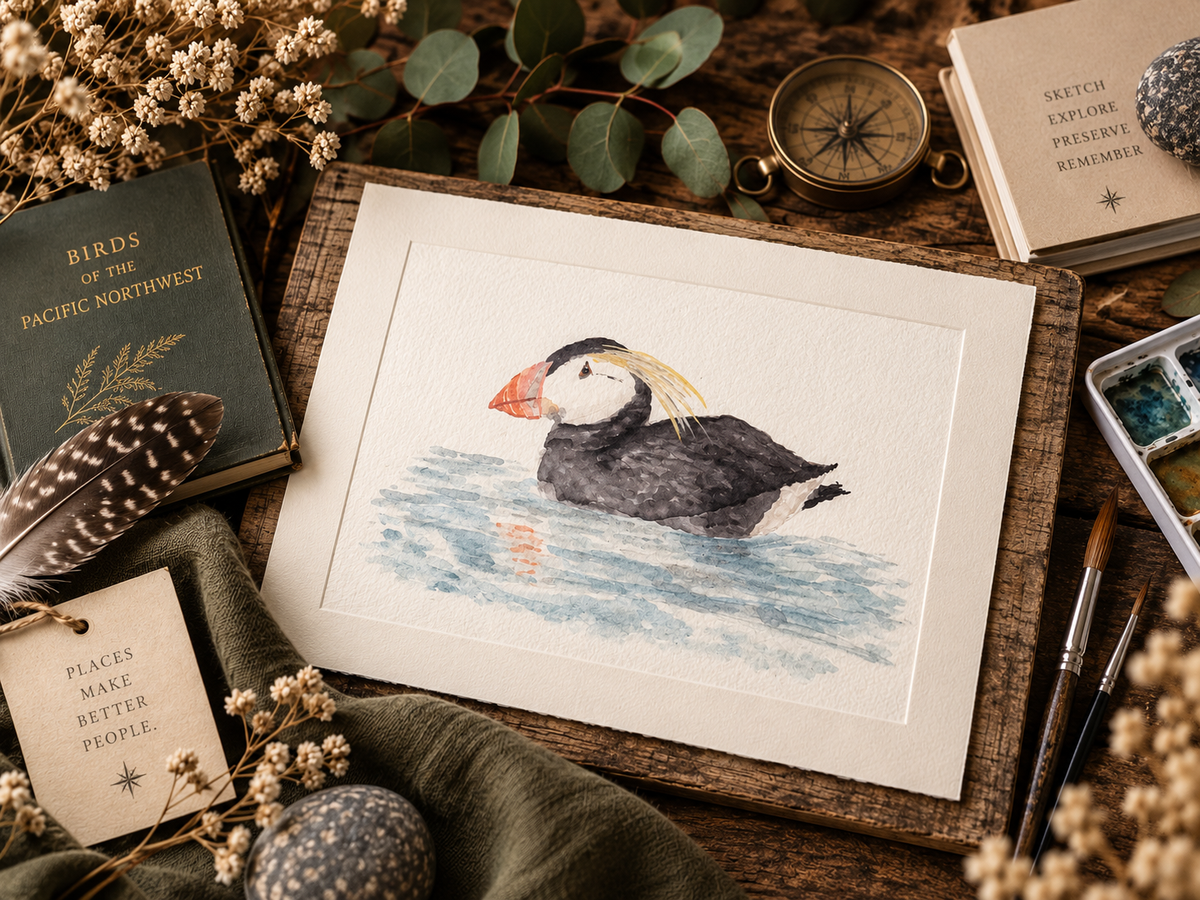
Not a particular photograph from the trip. I wanted the memory of one floating out there in the Salish Sea.
So I pulled out a 4 × 6 piece of watercolor paper—the size I paint most often—found a reference image, sketched him out and started painting.
And then I painted the wrong puffin.
Which was particularly irritating considering how much time I had now spent learning about puffins.
Something about the finished bird kept bothering me. I looked at him again.
White belly.
No tuft.
Atlantic Puffin.
After traveling around the Pacific Northwest looking for Tufted Puffins, I had somehow come home and painted his Atlantic cousin.
The realistic, factual half of my brain was not going to allow this.
The flowy watercolor-artist half of my brain was equally unhappy about the proposed solution, because I'd already painted his head black and now needed to somehow put a pale yellow-white tuft on top of it.
So I left him alone for a day.
Watercolor is not especially interested in your regrets, and this was going to require a plan.
Eventually, with some careful watercolor surgery, a tuft appeared over the black and my Atlantic Puffin became the bird we'd actually gone to see.
The water around him stayed deliberately loose and quiet. I wasn't trying to paint the Salish Sea. I only needed enough of it to put the puffin back where I remembered him.
Floating.
And that's still where he is.
When I look at the little painting now, I remember Cannon Beach first—the three gulls, the patch of grass, that flash of orange when we finally figured out where everyone was pointing.
I remember learning to find the slightly goofy flyer among hundreds of birds.
But mostly, I'm back on the boat.
I can feel the wind in my hair and the excitement around me as everyone searches the water. I can see the kelp moving across the surface and all those little dark shapes scattered between it.
And then, somewhere among them, I find him again.
A funny little bird floating in the Salish Sea.
Exactly where I left him.
Found on the rocks.
Found again at sea.
Remembered in watercolor.

Painted by hand. Made of Wonder.